Philosophy for Peace
Join a collaborative project to build the most resilient philosophical system for peace

My Vision
As a doctor, my professional life has been devoted to treating illness and its consequences. Yet there is another form of human distress that lies largely beyond the reach of medicine: the devastation caused by conflict. It can be more destructive, more widespread and far harder to resolve.
Medicine rests on biology and chemistry, and ultimately on physics. Peace, by contrast, depends upon politics. Politics itself rests on deeper beliefs about value, authority, justice, freedom, responsibility and the nature of society. If lasting peace is to be possible, these beliefs require a shared foundation, just as medicine depends upon a shared scientific ground. Philosophy can provide that foundation.
At the deepest level, I believe two ideas repeatedly divide humanity: first, that God is more important than people; and second, that some human beings are more important than others. But are either of these claims objectively true? Is God, as a matter of fact, more important than humanity? Is one group of human beings inherently more important than another? My answer is no.
My central conviction is that humanity will only establish a durable foundation for peace when it can answer both questions in the negative. The philosophical framework I have developed is called Dyology and it seeks to explain how God cannot be ontologically more important than human beings, and why recognising this is structurally necessary for peace. It also explains why peace cannot be sustained wherever one people, nation, religion or group regards itself as inherently more important than another.
If you agree with me - and perhaps even more importantly, if you disagree - I’d be delighted to collaborate on a project aimed at finding the strongest possible articulation of our common ground.
I hope you’ll join me.
Yours,
Robin

The Project
This project is a large collaborative effort involving specialists and non-specialists. It centres on the draft of the book Dyology: On Diversity and Equality, a work I’ve been developing for two decades. Here I present my strongest argument: genuine structural peace demands everyone believing no deity or human is superior.
For those who wish to explore the entire work, or a specific domain in greater depth, the PDF of the full manuscript is available, and each chapter can also be accessed individually in the library. I have also included a more accessible four-page summary of each chapter.
The summary below outlines the book’s philosophical structure, covering metaphysics, epistemology, the philosophy of religion, metaethics, free will and political philosophy.

The Book
Dyology: On Diversity and Equality begins with a small, yet undeniable premise that can survive doubt and follow its consequences all the way to questions of morality, religion, politics, conflict and peace. The twenty-four chapters are organised as an arch. Difference forms the bedrock. A footing is built from questions about reality, meaning and mind. Two sides then rise from it. One examines God, religious authority and theology. The other examines consciousness, value, morality, human choice and authority. The two sides curve toward each other through questions of punishment, purpose, democracy, theocracy and conflict. They meet at the keystone: an account of how peace can arise through the transformation of the preferences that generate conflict. The arch is also a map of dependence. Later conclusions carry the weight of earlier ones. This matters because the book does not ask the reader to accept the whole system at once. Every major claim can be challenged at the point where it enters the structure.
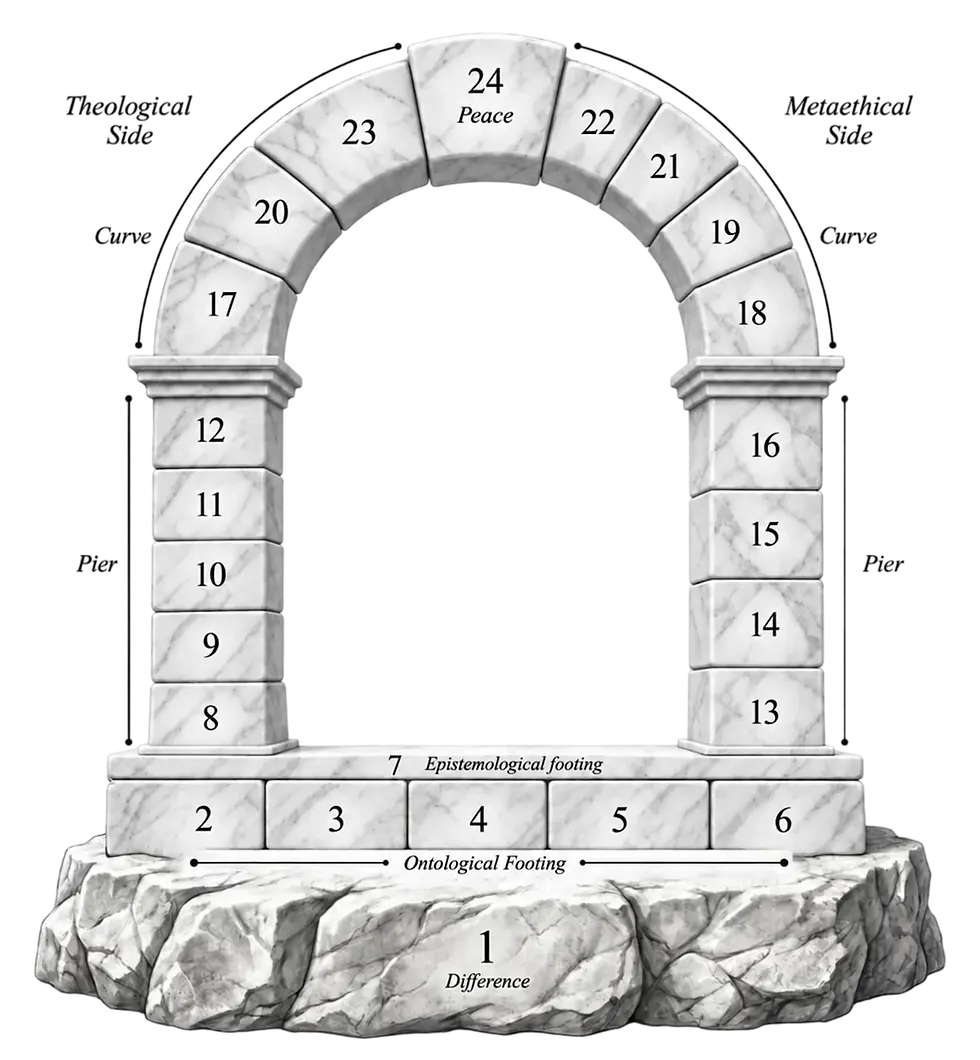
The Bedrock: Difference
The argument begins with a simple question: Is there anything that cannot coherently be denied? The book's answer is difference. Try to deny that any difference exists. The denial itself has a particular content. It differs from agreement, silence, another thought, or its own negation. The act of denying difference therefore contains the distinction it attempts to deny. The conclusion is deliberately modest: at least one difference obtains. From this starting point, the book asks what difference allows us to build.
The Footing: Ontological and Epistemological
Anything with determinate content must exclude something else. Red differs from blue. A triangle differs from a square. A thought about tomorrow differs from a thought about yesterday. Even a very abstract idea has content only because it is one thing rather than another. The book therefore treats contrast as fundamental to content. In other words, diversity is fundamental to meaning. From the fact that diversity exists, and meaningfully so, comes a larger claim. Any possible state of reality either contains at least one internal distinction or contains none. The book calls these two conditions diversity and equality. Diversity is the world we know: distinctions, relations, events, thoughts, objects and change. Equality is the limiting case: a condition with no internal distinction at all.
That second possibility becomes important because the book asks what happens when explanation, complexity and time are pushed toward their ultimate boundary. If a chain of explanation has an endpoint, the argument suggests that a fully structured endpoint would still contain features about which further questions could be asked. An undifferentiated condition presents a different kind of limit. There are no internal features left to explain. The same reasoning is applied to time. Temporal order requires distinguishable states. Where no distinction remains, there is nothing that could be earlier or later. This gives the book its concept of a terminus without diversity: a possible boundary of grounding and time containing zero internal complexity. Such a condition could not think, know, choose or experience. Every cognitive state involves distinctions of some kind: between one content and another, knower and known, desired and undesired, remembered and forgotten. The opening part of the book therefore reaches a striking result. The deepest possible limit of explanation, if there is one, would also be incapable of intelligence.
The same structure is then applied to meaning. Reality contains distinctions. Minds register some of those distinctions. Language attaches labels to some of what minds can register. The book describes these as three nested grids: the ontological, the epistemological and the linguistic. Reality can exceed what we know. What we know can exceed what we have words for. With that footing in place, the arch divides.

The Theological Side: Divine Authority
The theological side begins with a distinction between two very different meanings of infinity. Something may be infinite because its internal structure continues without end: more knowledge, more relations, more distinctions, more complexity. The book calls this infinite diversity. Something may also appear infinite because it contains no internal boundary at all. That is infinite equality. The two are structurally opposed. This creates a problem for forms of classical theology that describe God as both absolutely simple and infinitely knowing, loving, willing and intelligent. Knowledge and love require rich differentiation. Absolute simplicity removes internal differentiation.
The book follows this tension through several traditional arguments. Creation from literal nothing is examined first. “Nothing” cannot be an empty space or a blank condition, because those are already states with structure. Strict non-existence provides no state from which a transition could begin. Creation understood as continuing dependence can remain coherent; creation understood as a process beginning with non-being encounters the structural problem. The book then separates ground from mind. Something that explains why other things exist does not acquire intelligence simply by performing that explanatory role. A foundation of reality and a conscious agent require different structures. The kalām cosmological argument, divine simplicity and negative theology are examined in this light. The aim is not a general rejection of theism. The argument asks which combinations of divine attributes can coherently occupy the same place in the structure.
The theological side later moves from metaphysics to authority. Perfection is separated from infallibility. A person, institution or text can contain no known error while remaining capable of error. Religious dogma becomes problematic when a source of guidance is moved beyond the possibility of correction. The same analysis affects punishment. If human beings are never the ultimate authors of the entire causal history that formed their character and choices, then absolute desert becomes difficult to sustain. The book develops a restorative direction in which punishment increasingly concerns protection, repair and transformation.
The final theological application concerns the social consequences of creed. When religious allegiance becomes a measure of a person's moral standing, the book argues that theological separation can be projected into human relationships. It calls this the divine wall. If this side of the arch is broadly correct, no divine mind can simply be placed beyond the entire hierarchy of difference and then used as an unquestionable authority standing outside human disagreement.

The Metaethical Side: Human Authority
The second side begins from conscious life. The book proposes that mental states contain two broad dimensions. There is content—what we perceive, think or remember—and there is orientation—how experience pulls or pushes us, through pleasure, suffering, attraction, aversion, care and dislike. Value arises through this second dimension. A world containing facts without any capacity for experience could contain differences, structures and events. The book argues that nothing in such a world would yet be better or worse for anyone. Value enters when concious beings can register things as desirable or undesirable, pleasurable or painful, welcome or threatening. That makes value dependent on minds without making it arbitrary. If a person is suffering, the existence of that suffering does not depend on whether an observer recognises it. The affected person's experience anchors the evaluative fact.
From here the book develops its account of morality. Moral evaluation is centred on empathy: our capacity to register what chosen behaviour means for the conscious lives of others. Rules and principles remain essential. They preserve knowledge, coordinate behaviour and protect people when immediate empathy is unreliable. The book treats them as moral technologies built from accumulated human evaluation.
Choice is then analysed through the values that act upon us. Some responses arise directly from an experience. Others acquire strength through memory, association, education, expectation and anticipated consequences. Our preferences therefore have histories, and those histories can change.
This leads to the book's account of free will as bounded authorship. From inside a choice, deliberation is real. We compare possibilities and act. Looking backward, the person doing the choosing has a history they did not choose: temperament, biology, experiences, social environment and the arrival of thoughts and feelings themselves. Human authorship is therefore genuine within limits. Purpose is treated similarly. A purpose requires something toward which a person is oriented and a felt reason for moving toward it. It does not require endorsement from the universe as a whole. By the time this side of the arch reaches politics, the book has located value within the evaluative lives of conscious beings. Moral disagreement therefore has to be worked through within the field those beings share.
The central political question is now unavoidable. What can actually resolve a conflict? The book identifies three ways in which conflicting behaviour can change. The first is enforcement. A person retains a preference and is prevented from acting on it. The second is shallow persuasion. The preference remains, while another consideration becomes stronger. Fear of punishment, financial incentive, strategic compromise or deterrence may produce compliance. The third is deep persuasion. The preference that generated the conflict itself changes. This distinction gives the book its definition of structural peace. Deep persuasion requires contact between perspectives. A perspective must be capable of being expressed. It must encounter enough receptivity to be considered for its content. And the person holding it must not be excluded from the conversation before the perspective can even enter. The book calls these conditions expressibility, receptivity and non-exclusion. This leads to its account of democracy.

The Keystone: Peace
The two sides of the arch remove the two forms of authority that might otherwise be invoked to settle conflict from outside it. The theological side argues that no divine mind can stand beyond the hierarchy of difference as an unquestionable source of authority, while the metaethical side locates value within the evaluative lives of conscious beings themselves, rather than in a moral order existing independently of them. If both are broadly correct, conflict cannot be finally resolved by command. It can be resolved only when the preferences that generate it are themselves transformed. The book's final theological proposal is the companion God: a God within diversity whose relation to persons is persuasive rather than commanding. The companion fits the structure of peace because his mode of influence is the same one peace requires—engagement that can transform without overriding.
How to Collaborate
If you’re interested in collaborating or publishing with us on this project please email robinmains.author@gmail.com. Alternatively you can share your views, ideas, corrections or encouragement directly in the Hub.
In the Library section, you’ll find a [READ] link to the full text of every chapter and appendix, and to a [BRIEF] summary, written in a more accessible style.
I’ve also created a discussion group for each of the 24 chapters and 3 appendices. Access them directly from the hub or by clicking a [DISCUSS] link in the library. This is a great place for experts in specific fields or anyone interested in a particular topic like metaphysics ethics or theology to share their insights and contribute to the project’s progress.
